Why Coding & Robotics Matter for Future-Ready Students
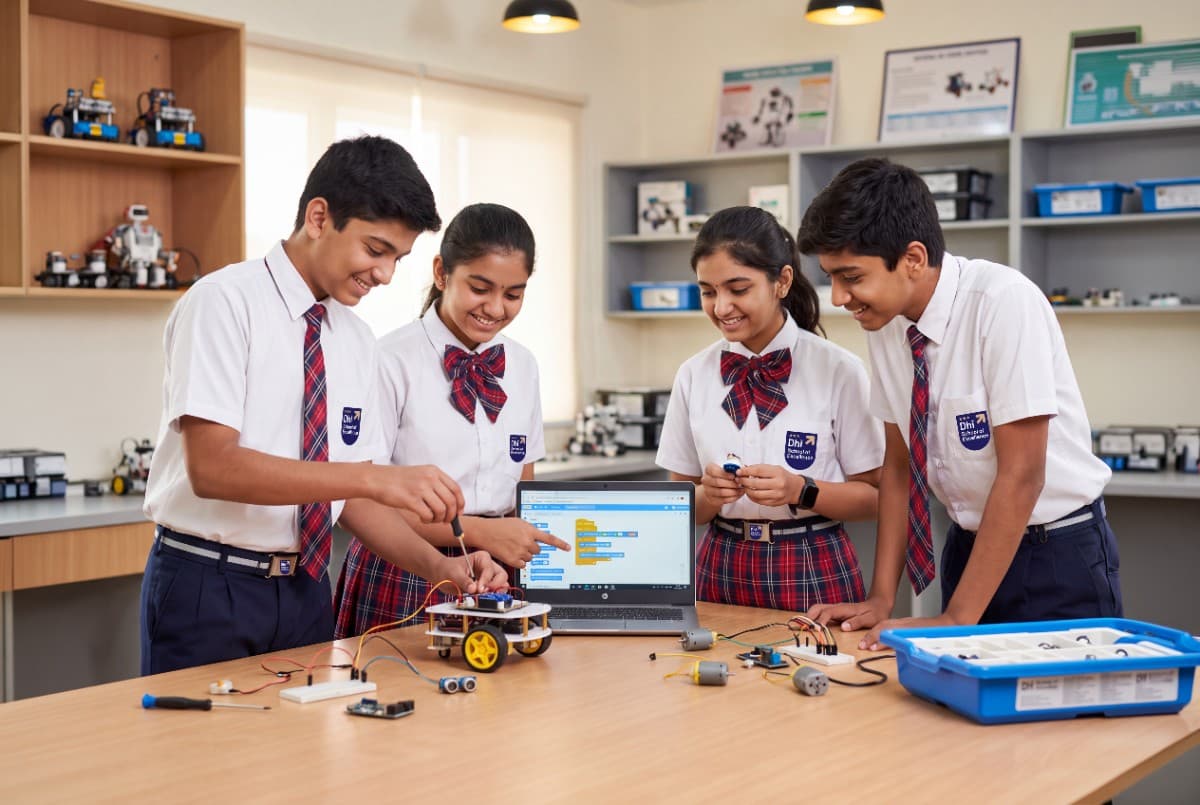
The way children learn is changing. Schools today are expected to do more than prepare students for exams. They also need to help children develop the skills they will need in a technology-driven world.
This is where coding and robotics can play an important role.
Coding teaches children how to give instructions to computers and solve problems step by step. Robotics takes this learning further by allowing students to build, program and experiment with machines.
But the value of coding and robotics goes beyond technology. These activities can help children develop logical thinking, creativity, problem-solving, teamwork, patience and communication skills.
For parents looking for schools that focuses beyond academics, learning coding and robotics can be an important part of a child's education.
What Are Coding and Robotics?
Coding is the process of writing instructions that tell a computer what to do. Children can begin with simple concepts such as sequences, patterns and commands before moving on to more advanced programming.
Robotics combines coding with physical objects. Students can use their programming skills to make a robot move, respond to instructions or complete a specific task.
For younger children, coding does not have to involve complicated programming. It can start with games, puzzles, visual programming and simple activities. As they become more comfortable, students can move towards programming, electronics, automation and robotics projects.
This makes coding and robotics for kids both practical and engaging.
1. Coding Builds Problem-Solving Skills
Coding teaches children how to approach a problem systematically.
When a programme does not work, students have to identify the error, understand what went wrong and find another solution. This creates a useful learning process:
Try → Make a mistake → Find the problem → Fix it → Try again.
Children learn that mistakes are not failures. They are opportunities to understand what needs to change.
This mindset can help them handle challenges in academics and everyday life.
2. It Develops Logical Thinking
Coding requires children to think in a clear sequence.
If they want a robot to complete a task, they need to decide what happens first, what comes next and what the robot should do if something goes wrong.
This teaches logical thinking and helps students understand cause and effect.
These skills can also support subjects such as mathematics and science, where students need to break complex problems into smaller, manageable steps.
3. Children Become Technology Creators
Children already use technology every day. They watch videos, play games and use smartphones and computers.
However, there is a difference between using technology and understanding how it works.
Coding and robotics gives students an opportunity to become creators rather than only consumers of technology.
Instead of simply playing a game, they can learn how one is created. Instead of watching a robot work, they can learn how to programme one.
This can build curiosity and confidence while helping children understand the technology around them.
4. It Makes Learning More Practical
Traditional learning often involves reading, writing and remembering information. Coding and robotics add a hands-on element.
A student learning about movement in science can apply that knowledge while building a robot. A student learning about measurements can use them while designing a project.
This connection between classroom concepts and real-world activities can make learning easier to understand and remember.
That is why coding and robotics classes can complement academic subjects rather than replace them.
5. It Encourages Creativity
Coding may appear to be a technical subject, but creativity is an important part of it.
There can be several ways to solve the same problem. Students working on a robotics project may come up with different designs or methods to complete a task.
Coding also allows children to create games, animations, stories and digital projects based on their own ideas.
This combination of logic and creativity can make coding especially valuable for young learners.
6. It Teaches Patience and Resilience
Technology does not always work on the first attempt.
A robot may not move as expected. A programme may contain an error. A project may need to be redesigned.
Students have to test their work, make changes and try again.
Over time, this teaches patience and resilience. Children learn to stay with a problem instead of giving up when the first solution does not work.
These skills can be useful in academics, sports, group projects and everyday situations.
7. It Develops Teamwork
Robotics projects often involve working in teams.
One student may focus on coding, another may work on the design, while another tests the robot. Students have to divide responsibilities, share ideas and work towards a common goal.
This teaches important social skills such as listening, cooperation and accepting different viewpoints.
These experiences show why education needs to go beyond academics.
8. It Improves Communication Skills
Creating a project is only one part of the learning process. Students may also need to explain how it works.
Presenting a coding or robotics project gives children opportunities to practise speaking, explaining ideas and answering questions.
This can gradually improve their confidence and communication skills.
9. It Can Support Emotional Intelligence
Coding and robotics can also contribute to emotional intelligence.
When students work on group projects, they learn to listen to others, manage frustration, accept feedback and work through disagreements.
When a project fails, they learn to handle disappointment and try again.
These experiences can help children develop patience, self-awareness and better ways of working with others.
10. It Introduces Children to Future Opportunities
Learning coding does not mean every child needs to become a software developer.
The purpose of early exposure is to help children understand how technology works and discover what interests them.
Technology is already connected to fields such as healthcare, finance, education, design, manufacturing and scientific research.
A coding and robotics course can therefore give students an early introduction to skills that may become useful in many different careers.
What Should Parents Look for in Coding and Robotics Education?
Not every programme will be suitable for every age group. Parents should look for learning that matches their child's age and ability.
A good programme can include:
- Age-appropriate coding activities
- Hands-on robotics projects
- Problem-solving challenges
- Team-based activities
- Creative projects
- Opportunities to test and improve ideas
- Project presentations
- A gradual progression from basic to advanced concepts
The objective should be to make technology interesting and understandable rather than overwhelming.
How Dhi School of Excellence Supports Future-Ready Learning
For parents searching for a school that combines academics with future-focused skills, Dhi School of Excellence is worth considering.
Dhi follows a curriculum that combines CBSE with an integrated Cambridge framework up to Grade V, followed by CBSE from Grade VI onwards. Its approach focuses on curiosity, creativity, critical thinking, communication and confidence.
The school also has dedicated learning spaces for robotics, computer science and AI, along with subject studios for science, mathematics, languages, music, dance and art. These facilities support practical learning, experimentation and collaborative projects.
This approach reflects an important idea: technology should not exist separately from education. It can become part of how children explore concepts, solve problems and create things.
For parents looking for the Best international schools in Kuntloor, Hyderabad, Dhi School of Excellence offers a combination of global learning approach, CBSE Curriculum and Cambridge frameworks while maintaining a focus on Indian values.
Dhi is located in Kuntloor, East Hyderabad, and its website currently states that school admission is open for Nursery to Grade 7 for the 2026–27 academic year.
Coding and Robotics Should Be Part of a Balanced Education
While coding and robotics are valuable, they should not become the only focus of a child's education.
Children also need strong language skills, mathematics, science, physical activity, arts, social interaction and emotional development.
A balanced school experience can bring these areas together.
A student can learn mathematics in the classroom, apply logical thinking through coding, work with classmates during a robotics project, participate in sports and develop communication skills through presentations.
This is what learning beyond academics should mean. It is not simply about adding more subjects to a child's schedule. It is about giving children different ways to learn and develop.
For parents comparing the Best Secondary Schools in Hyderabad, it is worth looking at how a school combines academic learning with technology, communication, creativity, sports and other practical experiences.
The Role of Schools in Preparing Future-Ready Students
Parents cannot be expected to teach every new technology at home. Schools have an important role in providing the right environment, teachers and resources.
A good school can introduce children to technology in a structured and age-appropriate way. It can provide access to robotics labs, computer science spaces and project-based learning.
More importantly, it can give students the freedom to experiment, make mistakes and try again.
This helps children understand that technology is not just something they use. It is something they can explore, understand and create with.
Final Thoughts
The future will need students who can do more than remember information. They will need to solve problems, think creatively, communicate clearly, work with others and adapt to change.
Coding and robotics can help develop many of these skills from an early age. Through practical projects and challenges, children can strengthen logical thinking while also building creativity, confidence, patience and teamwork.
However, future-ready education is not only about technology. It is about creating a balanced learning experience that prepares children for real life.
For parents looking for a school that combines academics with technology, creativity, emotional development and learning beyond the classroom, Dhi School of Excellence offers an approach worth exploring. With dedicated robotics and computer science facilities, hands-on learning and a focus on both global standards and Indian values, the school gives students opportunities to build skills that can support them well into the future.